Category: Insurance

  • What Happens When Term Life Insurance Expires?

    There are two types of life insurance policies: term and permanent.

    One of the most significant differences between the two is that term life insurance is a temporary product. It has an expiration date.

    What happens when term life insurance expires? Your coverage ends, and you stop paying premiums.

    In this guide, you’ll learn how long term life insurance lasts, what happens if you outlive your term life insurance, and if you can extend your coverage.

    Table of Contents

    Do Life Insurance Policies Expire?

    It depends on the type of policy you own:

    When life insurance coverage expires, you are no longer insured. If you die before the expiration date, your beneficiaries receive a death benefit check from the insurance company. If you die after the expiration date, your beneficiaries don’t receive a payout.

    Do you need term life insurance or whole life insurance? Learn more about the differences between the two in our guide. 

    How Long Does Term Life Insurance Last?

    Term life insurance offers fixed rates that last 10-40 years. So, if a 40-year-old buys a $500,000 20-year term policy for $30 per month, the cost remains $30 until it expires at age 60.

    Ideally, you buy term life insurance to financially protect your loved ones during their most vulnerable years. The years when, if you were to die unexpectedly, they would struggle financially due to losing your income.

    During these years, you may be:

    • Raising children
    • Saving for retirement
    • Paying off a mortgage
    • Running a business

    If you were no longer around to provide for your loved ones, what would they do? This is why families should have term life insurance. It’s planning for the what-ifs.

    Learn more: How Long Should My Term Life Insurance Last?

    Not sure how much life insurance you need?

    What Happens at the End of Term Life Insurance?

    At the end of your policy’s term, you no longer have to pay any premiums, and your coverage ends. The insurance company will typically send you a notice informing you that your coverage has officially ended.

    Can You Get Your Money Back?

    If you outlive your term life insurance coverage, you only get a refund if you purchase return of premium life insurance. Because you get a refund if you don’t die, ROP term life insurance is more expensive than traditional level term life insurance.

    For example, a healthy 40-year-old male can buy a traditional $500,000 term policy that lasts 20 years for $28.42 per month. The return of premium version would be $141.24 per month.

    Most people choose the cheaper term policy since investing the difference over those 20 years often makes more financial sense.

    What to Do When Your Term Life Insurance Is Expiring

    If your term life insurance policy is ending and you want to continue to make sure your family is protected, you have some options:

    1. You can buy a new policy.
    2. You can convert the policy into a permanent one.
    3. You can renew your term coverage.
    4. You can go without life insurance.

    Buying a New Policy

    If your health hasn’t changed much, buying a new term policy will be the least expensive way to continue coverage. You don’t need to buy the same coverage amount or term length as your original policy.

    For example, you purchased a 20-year term policy when your first child was born. You now have two children, one in college and one in high school. Perhaps you just want an additional 10-year term policy to ensure all your children are independent and no longer relying on you financially.

    Converting Your Term Policy

    Many term life insurance policies have a conversion rider automatically included. The rider would ensure you can convert your term policy into a permanent one regardless of your health status as long as you convert before the deadline.

    The benefits of converting a term policy:

    • You don’t have to go through underwriting or take a medical exam.
    • You maintain the original health rating from the term policy.
    • You can decide how much of the coverage to convert.
    • You get life insurance coverage for your entire lifetime.

    If you decide to convert, your premiums will increase drastically. You’ll no longer have a term policy. Instead, you’ll have a permanent policy, and permanent insurance is much more expensive.

    If you’re interested in converting, check the conversion expiry date listed on your policy.

    Renewing Your Term Coverage

    Many insurance companies have renewability options on their term products. This means you can extend the coverage term year after year without having to re-qualify.

    The catch is that renewable premiums are far higher than your initial fixed premium.

    For example, you purchased a $500,000 20-year term life insurance policy when you were 30. Your annual cost is $244.

    You’re now 50, and your policy expires this year. You can choose to renew the policy to extend the coverage another year. This means you’ll keep your $500,000 in coverage but no longer qualify for the $244 annual premiums. To renew the coverage, the annual premium is $2,989. Each year you renew, these premiums increase.

    For people who are diagnosed with a severe medical condition, this option can be life-saving for your loved ones. Imagine your term insurance is about to expire, and you’re diagnosed with terminal cancer. You can opt to renew your coverage to ensure you don’t leave your family with a pile of medical bills.

    The benefits of renewing a term policy:

    • Allows you to reclaim your coverage at the end of your initial term.
    • Allows you to keep your policy’s original face value amount (or death benefit).
    • Permits you to renew your term life policy without starting the application process again.
    • Exempts you from answering medical questions or undergoing a medical exam to prove insurability.

    No Longer Have Life Insurance

    If your expiration date is approaching, you can simply let the coverage run out. Depending on your situation and the stage of your life, you may not need life insurance anymore.

    You likely do not need life insurance if:

    • You have paid off your mortgage.
    • You have no significant debt.
    • You have no financially dependent children.
    • Your spouse does not rely on your income.
    • You’ve retired (or are retiring soon) and have sufficient savings.

    If you currently own a term life insurance policy, check when the conversion period expires, when your term expires, and if it can be renewed. If you aren’t sure how to find this information on your policy, contact your life insurance agent or broker.

    An annual policy review can help you ensure the end of your term policy doesn’t sneak up on you. Use our guide to understand when and why you should review your policy. 

    See what you’d pay for life insurance

    Comparison shop prices on custom coverage amounts from the nation’s top carriers with Quotacy.

    Talk to a Quotacy Agent to Understand Your Policy Options

    If the end of your term policy is approaching and you still want coverage, contact us here at Quotacy, and we can help you with the next step. Take a second to run a quote, too, so you know how much a new term policy may cost you.

    You don’t have to spend time shopping from company to company. Our quoting tool lets you receive instant term life insurance quotes from multiple companies. When you’re ready, complete your application online, and your agent will shop your case to ensure you get the best price. You don’t have to keep your previous life insurance company. You always have options. Make the best of them.

    Note: Life insurance quotes used in this article are accurate as of March 1, 2023. These are only estimates and your life insurance costs may be higher or lower.
    Watch the What If I Outlive My Term Policy Video

  • Things to Know About Owning Life Insurance

    Who can get life insurance? What are the related terms of coverage and responsibilities? When it comes to being the owner of a life insurance policy, there are three distinct roles related to one policy you should know about:

    • the owner of the policy,
    • the insured person, and
    • the beneficiary.

    When you get life insurance, the policy covers one person’s life, called the insured. The policy owner is the individual who has purchased the coverage on the insured’s life. The beneficiary is the person (or people) who will receive the death benefits (the money that is paid out by the life insurance company) when the insured dies. In this article, Quotacy focuses on the role of the owner of the policy and what it means to get life insurance.


    Key Takeaways 

    The owner of a life insurance policy has control over the policy. The insured and policyowner are often the same person, but not always. The policyowner and beneficiary can also be the same person, but the insured and beneficiary cannot be the same person.

    Being a policyowner has its benefits, but also the responsibility to keep the policy inforce, or active. A policyowner should also review the policy occasionally to make sure it still fulfills insurance needs.

    Who can get life insurance?

    Any person (an adult, not a minor) or legal entity can own life insurance on another person as long as there is insurable interest and mutual consent.


    Insurable Interest: Insurable interest exists when the death of one person would negatively financially affect another person.

    The most common example of insurable interest is a spousal relationship. If one spouse died, the surviving spouse would likely have trouble continuing to maintain his or her same standard of living (paying the mortgage, raising children, etc.) on one income. 

    Below are some common scenarios for the owner of the policy and the insured:

    • A husband can get life insurance on his wife or same-sex husband (and vice versa),
    • A parent can get life insurance on a child,
    • A business owner can get life insurance on a key employee,
    • A business co-owner can get life insurance on another co-owner, and
    • You can get life insurance on yourself.

    What does it mean to be a policyowner of life insurance?

    Life insurance policy ownership means you have full responsibility and control of your policy.

    Being the owner of a life insurance policy means:

    • You determine how long your coverage lasts; either the length of your term life policy or lifelong, permanent coverage.
    • You are responsible for paying the policy premiums each month or annually.
    • You may transfer ownership of your policy.
    • You choose the beneficiaries and change them, if necessary.
    • You determine how the beneficiaries receive the death benefit proceeds.
    • You can borrow against or withdraw from policy cash values, if you own permanent insurance.
    • You can surrender or cancel your policy.
    • You may review your policy occasionally to ensure it’s beneficial for you and your family.

    When should owners review their life insurance policies?

    Below are four common life events when we recommend that you review your life insurance policy:

    1. If you get married or divorced,
    2. If you have a baby or adopt a child,
    3. If you purchase a new home or a second one, and
    4. If you change jobs.

    Marriage or Divorce

    You would be surprised at how often someone with life insurance dies and ends up leaving their current spouse with nothing because their ex-spouse is still listed as the primary beneficiary of their life insurance policy.

    If the policyowner forgets to update his policy to reflect the needed change of beneficiary, there is nothing the should-have-been-beneficiary can do about it.

    New Baby or Adopted Child

    If you purchased life insurance before having children (or adopting) and only purchased enough to cover your mortgage, but not the costs of raising your child or college tuition, consider purchasing more coverage.

    Don’t forget to add any new children to your policy as well. However, if you name your children as beneficiaries and die before they reach legal age, the court will appoint a guardian to handle the proceeds until the child reaches 18 or 21, depending on the state. This is a costly and inconvenient process which is why we don’t recommend listing young children as beneficiaries.

    » Learn more: Naming Minors as Beneficiaries: UTMA and UGMA

    Instead, you should set up a trust to benefit the child and name the trust as the beneficiary of your life insurance policy or name an adult custodian for the life insurance proceeds under the Uniform Transfers to Minor Act (UTMA).


    Example 

    John Smith and his ex-wife Jane have a 10-year-old child named Lola. When he bought his life insurance policy, John set it up so that 100% of his death benefit would go to Jane, as custodian of Lola, his minor child.

    John remarried. He and his new wife Nancy had a baby named George. John decides to update his life insurance policy so that 50% of his death benefit will go to Jane, as custodian of Lola, and 50% of his death benefit will go to Nancy, as custodian of George.

    Good job, John. He just saved the moms of his kids a lot of stress and strain.


    New Home or Vacation Home

    Selling your bachelor pad and buying a house for your growing family? You may need more life insurance coverage to cover your mortgage.

    If you’re buying your dream vacation home in the Florida Keys after you retire, you may want to take out another term life insurance policy to cover your extra mortgage payments. This can ensure your spouse or life partner can enjoy the fruits of retirement even if you were to unexpectedly die.

    New Job or Contract Work

    It’s a nice bonus if your employer offers a group life insurance plan, but when you change jobs, your plan won’t follow your new career move. It’s always a good idea to review your financial portfolio when you get a new job. Not all employers offer life insurance, so if you have a family, we recommend buying an individual life insurance policy to ensure you’re covered.

    » Learn more: Do I Need Individual Life Insurance if I Have Group Life Insurance?

    If you get a promotion that increases your monthly income substantially, will your family’s lifestyle change? This new salary may mean new cars, private school for the kids, or maybe even a lavish home. You may need to increase your coverage to protect your family’s new standard of living.

    See what you’d pay for life insurance

    Comparison shop prices on custom coverage amounts from the nation’s top carriers with Quotacy.

    Should I own my life insurance policy?

    It’s quite common for an individual to be both the owner of the policy and the insured. Being both the policyowner and the insured keeps things pretty simple. Your life is strictly in your hands. There are certain situations, though, when this isn’t the best choice.

    If you own your own policy, the proceeds become part of your federal taxable estate if your estate exceeds the exclusion amount. The exclusion amount for 2018 is $11.2 million per person, though this expires on December 31, 2025. State estate taxes differ by state and are in addition to the federal taxes. This includes any property you would leave to heirs as well.

    Most Americans will not have this estate tax issue, however.

    There is an exception to the estate tax rule. If you own your own life insurance policy and the beneficiary is your spouse, the policy proceeds are not included in your estate via the marital deduction law. You can transfer an unlimited amount of property to your spouse and not get hit with an estate tax.

    Cross-ownership between spouses is also common. This means that a husband would be the owner of a policy in which the wife is the insured and vice-versa. The benefit to this is that because you are in charge of the policy on your spouse, you know you are financially protected should the unexpected occur and you have easy access to all the information required to receive the death benefit.

    » Learn more: When Should Someone Else Own My Life Insurance?

    How can I change the owner of my life insurance policy?

    If you are the owner of your policy, you can transfer ownership. All you need to do is fill out a simple form and send it to the life insurance company. You can call the life insurance company directly and ask for this form. If Quotacy is your agency, you can always call us and we will get you the forms you need.

    To fill out a change of ownership form, you’ll need the new owner’s following information:

    • First name, middle initial, last name
    • Their relationship to the insured
    • Address
    • Phone number
    • Social Security number

    A trust or organization can also own a life insurance policy. With these owners, you may need a few more pieces of information, such as what type of business it is (LLC, Inc., etc.) or the name of the trustees—but it is typically still the same simple change of ownership form.

    When transferring ownership of a policy, there are some tax issues to consider. If you change owners to avoid estate taxes, but die within three years of making this change, the policy proceeds may still be included in your estate. When transferring ownership, the IRS also requires you to forfeit all legal rights to the policy. If any incidents of ownership occur by the person who transferred the policy, it may cause the policy to lose certain tax benefits.

    The action of changing the owner of your policy may be simple, but check with a financial professional to see if there will be tax consequences. Before changing ownership, call your Quotacy agent to discuss the potential changes you want to make. If you have any further questions about policy ownership or are looking to change the owner of your policy, feel free to contact us. We’re happy to help.  If you don’t have life insurance, get life insurance quotes at Quotacy today.

  • How to Find Out if Someone Has a Life Insurance Policy

    The death of a loved one is never easy. There is a lot to manage while dealing with grief.

    If you aren’t sure if your loved one had a life insurance policy, this guide can help you find out.

    4 Steps to Take to Find a Life Insurance Policy

    Whether or not someone has a life insurance policy can be a game-changer for the loved ones they leave behind. Perhaps your loved one told you they had a life insurance policy, but never told you where to find it. Or perhaps they never said anything and you’re wondering if a policy exists. Use these steps as a guide.

    Step 1: Check Personal Records and Belongings

    The first step is to just start looking through your loved one’s documents. You may stumble upon the policy itself or clues that one exists. For example, look for notifications from insurance companies or premium payment receipts.

    • Gather your loved one’s bank statements. Read through them to see if any regular payments were being made to a life insurance company.
    • Go through the mail. Keep a close eye on the deceased’s mail for many months after their death. There may be policy premium notices, dividend notices, policy service notices or statements.
    • Look through storage areas. Check storage areas for evidence of life insurance, such as the policy itself or payment receipts. Storage areas could be filing cabinets and desk drawers. Did your loved one have a safe or a safety deposit box? Check those as well. If you do not have access to the safety deposit box, you will need to bring the death certificate along with an executor’s testament to the bank. Spouses typically only need a death certificate and marriage certificate.
    • Read through address books. Address books, whether they are paper or stored on a cell phone, may contain clues about a life insurance policy, such as the phone number to a life insurance company or agent.
    • Review tax returns. Go through your loved one’s income tax returns from previous years to see if there are claims for interest earned on any life insurance policies.

    Step 2: Contact Your Loved One’s Financial Professionals

    If you don’t find much by going through your loved one’s belongings, the next step is to start contacting any financial professionals they worked with. This may include lawyers, tax accountants, financial advisors, or lenders. These individuals may know if a life insurance policy existed.

    Step 3: Check With Your Loved One’s Employer

    Many employers offer group life insurance to their employees. Even if your loved one was retired, some people choose to take their life insurance with them when they leave the company. The company’s human resources department can assist you or at least give you the insurance company’s information.

    Step 4: Get Assistance From Outside Resources

    If the previous steps were unsuccessful, you may want to seek help from independent parties.

    • Contact your state’s insurance department. The National Association of Insurance Commissioners (NAIC) website can help you find your state’s insurance office contact information. It’s a good place to start if you haven’t had luck elsewhere. Some states have online locator tools to search for missing life insurance policies as well.
    • Use online resources to help your search. Websites such as the NAICmissingmoney.com, and unclaimed.org allow users to search for unclaimed assets. The death benefit from a life insurance policy is considered an asset.
    • Pay a company to search for you. In addition to looking on your own, there are several companies out there who will search for a lost life insurance policy on your behalf. A few popular companies are MIB and Policy Inspector. They will typically contact hundreds of life insurance companies to find out if your loved one had a policy. Each company has different limitations and rates, so choose wisely. Be aware that there are scammers out there who will say they want to help you find unclaimed money for an up-front payment and then are never heard from again. Do your research before hiring a company.

    Not sure how do make a life insurance claim? Read our guide for the answers: Life Insurance Claim Process: How to File & How Payouts Work

    See what you’d pay for life insurance

    Comparison shop prices on custom coverage amounts from the nation’s top carriers with Quotacy.

    Life Insurance Policy FAQs

    Will the insurance company reach out to me if I’m a beneficiary?

    In most cases, no. Insurance companies don’t automatically know when their clients die. It’s up to the policy beneficiary to reach out to the insurance company to file a claim when someone dies.

    What information do I need to make a claim?

    To make a claim, you need the following documentation:

    • Deceased’s full name
    • Social Security Number (SSN)
    • Death certificate
    • Proof of your relation and/or identity

    To start the process, simply contact the life insurance company that issued the policy and they’ll provide you with instructions.

    What happens to the death benefits if no one claims the money?

    If life insurance policy death benefits are not claimed after a few years, the insurer turns the funds over to the state government. Even then, beneficiaries can still file a claim for the money through the state’s unclaimed property program.

    Who is allowed to request life insurance information?

    Life insurance companies are very strict about privacy. You cannot just call in asking about people’s insurance policies, even if you’re related to the person.

    Insurance companies will typically only release information to:

    • Next of kin (e.g., deceased spouse or child)
    • Any designated beneficiary on the policy
    • Estate executors and trustees

    It’s unfortunate how many life insurance benefits go unclaimed. Although life insurance isn’t exactly a fun topic of conversation, it’s an extremely important one.

    If you have life insurance, talk to your family about it.

    Watch the How to Find a Life Insurance Policy Video

  • How Much Does a $100,000 Life Insurance Policy Cost?

    The cost of a $100,000 life insurance policy varies depending on the type of policy, and your individual factors such as age, gender, health, and lifestyle habits.

    The most affordable option is a $100,000 term life insurance policy. See for yourself. Get a quote for $100,000 of term coverage instantly using our free quoting tool. No need to give away any contact information in order to see real-time pricing estimates.

    Table of Contents


    See what you’d pay for $100,000 of life insurance

    Comparison shop prices on custom coverage amounts from the nation’s top carriers with Quotacy.

    How Much Is a $100,000 Life Insurance Policy?

    The cost of a life insurance policy is determined by a number of factors such as gender, age, and your health status. Another main factor is whether you decide to buy a term or whole life insurance policy.

    A term life insurance policy is temporary coverage lasting 10-40 years. Because of its simplicity and affordability, it’s the most common choice for families.

    Whole life insurance lasts your entire life and has a savings component you can access via policy loans. It’s typically 10-15 times more expensive than term. In addition, participating whole life policies in which you can earn dividends are often slightly more expensive than non-participating.

    Below are cost examples for a few $100,000 term and whole life insurance policies, so you can compare rates.


    Cost of a $100,000 Life Insurance Policy: Term vs Whole

    Life Insurance for a Healthy 35-Year-Old Male
    Policy Type Monthly Rate
    20-Year Term Policy $8.77
    30-Year Term Policy $13.49
    40-Year Term Policy $19.79
    Whole Life Policy (non-participating) $80.10
    Whole Life Policy (participating) $119.71

    The quotes shown are based on a Preferred Plus risk class. The whole life quotes are for policies with premiums payable to age 100.

    One strategy people take is buying a large term policy for their big-ticket items, like the mortgage and cost of raising children, and supplementing it with a smaller $100,000 whole life policy.

    This way, should you die unexpectedly, your family can continue to pay bills without struggle due to the death benefit they are paid. And if you outlive your term policy, you still have a whole life policy that provides a guaranteed death benefit for end-of-life expenses.

    However, not everyone needs whole life and some families are better off saving that money and redirecting it toward other needs, like emergency funds or retirement savings.

    Cost of a $100,000 Life Insurance Policy by Term Length

    Term life insurance is the best option for most families. You choose how long your coverage should last between 10 to 40 years.

    Ideally, you have this coverage in place during your prime earning years. The years you’re saving for retirement, raising kids, and paying off a mortgage. With a term policy, if you were to die unexpectedly, your family avoids financial struggle.

    Monthly Cost of a $100,000 Life Insurance Policy by Term Length
    Term Length Male, Age 35 Female, Age 35
    10-Year Term $7.96 $7.22
    15-Year Term $7.97 $7.64
    20-Year Term $8.77 $8.04
    25-Year Term $12.01 $10.34
    30-Year Term $13.49 $11.47
    35-Year Term $16.56 $14.26
    40-Year Term $19.79 $17.19

    The quotes shown are based on a Preferred Plus risk class.

    Cost of a $100,000 Life Insurance Policy by Age

    Age is one of the biggest factors in determining the cost of life insurance. Because life insurance companies pay a large check if you die, the closer you are to the end of your life expectancy, the higher their risk. Therefore, older individuals pay more for life insurance than younger people.

    And both term life insurance and whole life insurance offer fixed rates, which means your monthly premium will never increase during the life of that policy.

    Monthly Cost of a 20-Year $100,000 Life Insurance Policy By Age
    Age Male Female
    25 $8.38 $7.77
    30 $8.47 $7.88
    35 $8.77 $8.04
    40 $10.53 $9.43
    45 $15.18 $12.74
    50 $21.34 $16.68
    55 $33.52 $24.06
    60 $52.27 $37.14
    65 $96.91 $65.31
    70 $201.61 $167.78

    The quotes shown are based on a Preferred Plus risk class.

    Monthly Cost of a $100,000 Whole Life Insurance Policy By Age
    Age Male Female
    25 $84.04 $74.82
    30 $100.05 $87.26
    35 $119.71 $101.70
    40 $149.81 $123.19
    45 $184.18 $148.68
    50 $227.68 $189.66
    55 $288.06 $240.12
    60 $372.88 $240.12
    65 $484.24 $404.72
    70 $628.75 $564.89

    The quotes shown are based on a Preferred Plus risk class. Policy is a participating whole life policy with premiums payable to age 100.

    Cost of a $100,000 Life Insurance Policy Based on Health and Lifestyle Habits

    When you buy life insurance, your entire application is reviewed. In addition, insurers often review your medical history and other records, such as motor vehicle and criminal records.

    During this process, called underwriting, you’re assigned a risk class. This classification ultimately determines the cost of your policy.

    If you’re an average risk, you will be assigned the Standard risk class. If you’re less risky than the average person of your same age, you can qualify for Preferred risk classes. If you’re riskier than average, you may receive substandard ratings. If you use tobacco, you will likely be assigned either Preferred Tobacco or Standard Tobacco depending on your use and current health status.

    Risk Class 20-Year Term Policy Whole Life Policy
    Preferred Plus $8.77 $104.14
    Preferred $10.31 $108.92
    Standard Plus $14.03 $111.01
    Standard $14.32 $113.10
    Preferred Tobacco $25.62 $135.81
    Standard Tobacco $32.80 $141.64
    Substandard Table 2 Non-Tobacco $17.23 $128.98
    Substandard Table 3 Non-Tobacco $18.82 $136.92
    Substandard Table 4 Non-Tobacco $20.42 $144.86

    The monthly quotes shown are for a 35-year-old male. Whole life policy is a participating plan with fixed monthly premiums for life.

    When Does $100,000 of Coverage Make Sense?

    A $100,000 term life insurance policy makes sense:

    • For those who are on a limited budget, but still want to ensure their loved ones are protected from the unexpected;
    • If you don’t have a lot of debt you’d leave behind, but still want income replacement for your family;
    • If you’re laddering policies and this policy is for a specific protection goal.

    Example of Laddering

    You and your spouse purchased a home with a 30-year $300,000 mortgage. You have a teenager graduating from high school next year and want to support her through college.

    You can buy two different life insurance policies that are specific to ensuring your family can remain in their home and financially protecting your child.

    • A 30-year $350,000 term life insurance policy will provide the cash your spouse needs to continue paying monthly living expenses if you die before the mortgage balance is paid.
    • A 10-year $100,000 term life insurance policy will provide the cash your family needs to support your daughter through college and her young adult life until she’s financially dependent, even if you die and can’t physically be there to see her through it yourself.

    A $100,000 whole life insurance policy makes sense:

    • If you need lifelong protection for your loved ones. Perhaps you have a non-working spouse or a child with special needs.
    • If you aren’t sure how long people will be relying on you, then whole life insurance may be a good option.
    • As a supplement to a larger term life insurance policy.

    Need some of both? Purchase enough term life insurance to cover all your debt and financial responsibilities. And choose a long enough term length to protect your family until all or a majority of your debt is paid off. Then buy a small whole life insurance policy to cover end-of-life expenses and leave behind a small inheritance.

    Learn more about this strategy: Supplementing Term Life Insurance with Whole Life Insurance

    Is $100,000 Enough Life Insurance?

    A $100,000 term life insurance policy may not be enough for some people. And you may be surprised at how affordable higher amounts of term life insurance can be.

    The difference in cost between a $100,000 and $250,000 term life insurance policy may be as little as $2-3 per month. How much more secure would your family be with an extra $150,000 if you died unexpectedly?

    I encourage you to use our life insurance quoting tool and play around with the coverage amounts and term lengths. See for yourself how affordable term life insurance is.

    If you’re looking to supplement term life insurance, a $100,000 whole life insurance policy is a good amount of permanent coverage. Not all families need permanent life insurance, however.

    Buy what you can afford. $100,000 of term life insurance is a million times better than no life insurance.

    Can I Get a $100,000 Life Insurance Policy With No Exam?

    Many companies offer no-exam options for small face amounts like $100,000 life insurance. In fact, many of the companies we work with here at Quotacy have no-exam options up to $1,000,000 of term life insurance coverage.

    Buying $100,000 of whole life insurance coverage without an exam is a bit trickier, unless you get guaranteed-issue whole life, but these policies have limited benefits and are more expensive than traditional whole life.

    Contact Quotacy and speak with an agent directly to learn about what options you have to buy whole life insurance without an exam.

    In most cases, to qualify for no-exam options you need to be in good health. But not all life insurance companies underwrite the same way, so some have more lenient qualification requirements than others. If you prefer to skip the medical exam, your agent will let you know if you qualify.

    If something happens to you, life insurance can help financially protect the loved ones you leave behind.

    Our life insurance needs calculator can help you determine the right amount of coverage you need. Check it out here: life insurance calculator.

    If you prefer to talk with an advisor to determine how much life insurance you need, contact us directly here at Quotacy. Our agents are happy to go over your needs, but won’t push you into buying coverage you don’t need.

    Note: Life insurance quotes used in this article are accurate as of March 14, 2023. These are only estimates and your life insurance costs may be higher or lower.

    Watch the $100,000 Life Insurance Policy Video

  • Do I Need Term or Whole Life Insurance? Differences, Pros & Cons

    Our goal is to educate and advise on life insurance options, so you can feel confident in making the right choice, whether that’s through Quotacy or somewhere else. To ensure we provide accurate and trustworthy information, our writers follow strict editorial standards.

    Term life insurance is a simple, temporary, and affordable way to protect your loved ones from financial disaster during your prime earning years. 

    Whole life insurance offers permanent coverage, builds cash value, and is far more expensive than term. 

    If you’re wondering, “Do I need term or whole life insurance?” The best place to start is reviewing your finances and goals. In this guide, you’ll learn the differences between term and whole life insurance and which is best for you.

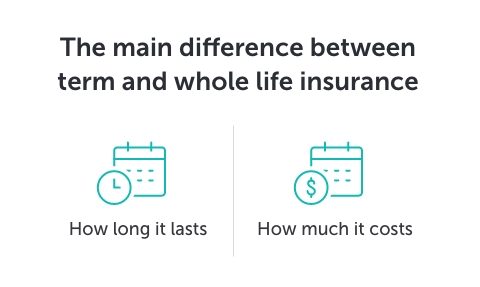
    Graphic titled 'The main difference between term and whole life insurance' beneath there are two icons, one representing 'policy length' the other representing 'policy cost'

    What Is the Difference Between Term and Whole Life Insurance?

    Life insurance policies come in one of two categories: term and permanent. There are a host of permanent policy options, and whole life is one of them. All permanent policies provide coverage for the rest of your days, but whole life insurance is one of the most common choices.

    The main differences between whole and term life insurance are how long it lasts and the cost. 

    • Term life insurance lasts a specific length of time, e.g., 10-40 years, and pays a death benefit if you die during the term. Whole life insurance is lifelong and pays a death benefit no matter when you die.
    • Term life insurance is basic financial protection for your beneficiaries. Whole life insurance protects your beneficiaries and accumulates cash value that you can access while living. Some whole life insurance policies also pay dividends.
    • Term life insurance is affordable and can be customized to fit most budgets. Because of its features, whole life insurance is about 10-20 times more expensive than term.

    Term Life Insurance

    Term life insurance is temporary life insurance coverage. It’s designed to last for a set period and terminate when you no longer need it. Many people buy term life insurance when they get married or have their first child and choose a term length to carry them to retirement.

    Term life insurance is the most affordable type and can be adjusted to fit most budgets. Length options range from 10 to 40 years, and coverage amounts range from $50,000 to over $65 million. If you die within the active term period, the insurer will pay your beneficiary(ies) the policy’s death benefit.

    When you buy a term life insurance policy, you lock in your rate for the entire term. Your price will stay the same as you age or if you develop a medical condition.

    Most term life insurance policies have conversion and renewal options built into the policy. These options are helpful if you decide you need life insurance but are now likely uninsurable.

    Learn more about extending term life insurance coverage here: What Happens if I Outlive My Term Life Insurance Policy?

    Whole Life Insurance

    Whole life insurance is life insurance coverage that lasts your entire life. As long as you keep your policy inforce, the life insurance company pays your beneficiary(ies) the policy’s death benefit no matter when you die.

    Whole life insurance also has a cash value component that steadily grows over time at a fixed rate. Once you’ve built up enough value, you can borrow against your policy in the form of loans or withdrawals.

    There are pros and cons to this, though. The policy loan accrues interest and reduces your death benefit unless you pay it back. A withdrawal permanently decreases the death benefit.

    Whole life insurance is typically about 10-20 times more expensive than term. This is because of its lifelong coverage, savings component that builds cash value, and dividends.

    Whole life insurance coverage varies from $10,000 to over $65 million. This is the amount your beneficiary(ies) receive upon your death.

    As far as permanent life insurance plans go, whole life insurance is one of the least complicated.

    Other permanent life insurance plans include:

    • Guaranteed Universal Life: The most simple form of permanent life insurance. It’s cheaper than whole life because it doesn’t offer much cash value potential—an excellent option for families who need lifelong coverage but can’t afford whole life insurance premiums.
    • Universal Life: Features include flexible premiums and the option to increase your death benefit. Cash values fluctuate with market interest rates.
    • Indexed Universal Life: Similar to universal life insurance, but cash values are tied to a stock market index. With an IUL, there’s more risk and potential for more reward compared to previously mentioned types of permanent life insurance.
    • Final ExpenseType of permanent life insurance for which you can’t be turned down if you’re 50 to 80 years old. There are no medical questionnaires or exams. Final expense policies have small coverage amounts, often between $2,000 and $25,000, yet have high premiums due to the guaranteed acceptance factor. It’s often referred to as last-resort life insurance.

    Unsure which type you need? Contact our experts to learn more about whole life and term life insurance policies.

    See what you’d pay for life insurance

    Comparison shop prices on custom coverage amounts from the nation’s top carriers with Quotacy.

    Term vs Whole Life Insurance: Pros and Cons

    Here’s a quick summary of the features of term and whole life insurance.

    Term Life Insurance

    Pros:

    • Affordable
    • Level premiums
    • Many term length and coverage options
    • Conversion and renewal options

    Cons:

    • Fixed level premium coverage expires
    • Expensive to convert or renew later on
    • No refunds when policy expires


    Whole Life Insurance

    Pros:

    • Level premiums
    • Cash value accumulation
    • Potential dividend payouts
    • Guaranteed payout to your beneficiaries

    Cons:

    • Very expensive
    • Accessing the cash value has consequences


    Term vs Whole Life Insurance: Which Is Better for You?

    The main goal of life insurance is to protect your loved ones during their most financially-vulnerable years. In most cases, term life insurance makes the most economic sense since you only pay for coverage during those vital years.

    However, whole life insurance has many benefits and can be the right choice in some circumstances. Let’s go over some scenarios to help you decide.

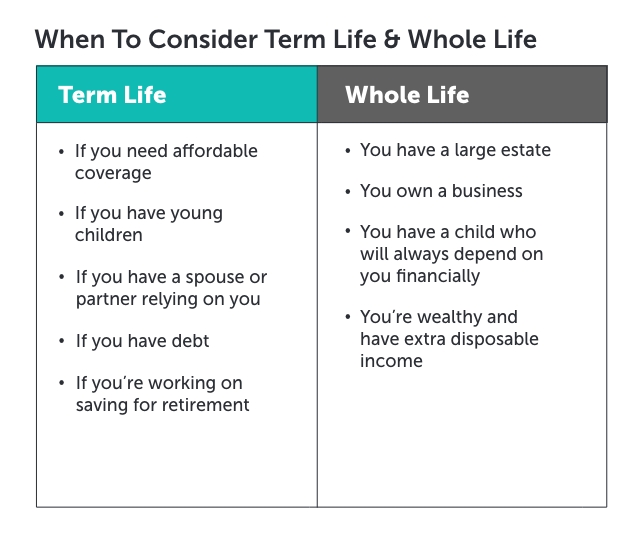
    Graphic titled 'when to consider term life and whole life' beneath is a table comparing term and whole life showing when to choose each option.

    Guidelines for Choosing Term Life Insurance

    If you have a young family and a mortgage, your loved ones are in their most financially-susceptible years. Your spouse and children may be dependent upon your income. If you were to die suddenly, would they be affected financially? This is where term life insurance can be indispensable.

    Are you on a budget?

    If you want a budget-friendly policy, term life insurance is ideal because it’s inexpensive.

    A small $100,000 life insurance policy can go a long way for a struggling family, and its premiums won’t affect your monthly budget too much. Even if you’re not in stellar health, a $100,000 policy is affordable.

    Do you have outstanding loans?

    Term life insurance is sensible if you have loans because you can dictate how long you want coverage.

    For example, let’s say you and your spouse just purchased a house for your growing family. Your mortgage loan is a 30-year term. Buying a 30-year term policy makes the most sense. It will be the financial backup should you die unexpectedly and ensure your family won’t have to sell the house.

    Term life insurance is an affordable way to protect your family from any debt they may be responsible for upon your death.

    Are you a good saver?

    If you’re a good saver, purchasing term life insurance to protect your family for an absolute number of years is beneficial. Your family has the protection they need when they need it. The protection drops off later in life when your children are grown, the mortgage is paid, and you have healthy retirement savings built-up.

    Like many types of insurance, term life insurance is a product you hope you never have to use.

    When to choose term life insurance:

    • If you need affordable coverage.
    • If you have young children.
    • If you have a spouse or partner relying on you.
    • If you have debt.
    • If you’re working on saving for retirement.

    Guidelines for Choosing Whole Life Insurance

    Whole life insurance is expensive. But if you can easily afford the premiums, it can be beneficial to have in your portfolio.

    Do you have a child with special needs or a disability?

    If you have dependents who rely on you long-term, then a whole life policy is best. However, if lifelong dependents are the only reason you’re considering whole life, guaranteed universal life insurance may be the better choice because it’s less expensive.

    Do you have a large estate?

    Whole life insurance can benefit your heirs if your estate is worth millions of dollars. They can use the death benefit to pay estate taxes, so they’re not forced to sell valuable or sentimental assets.

    Do you own a business?

    Life insurance is helpful for business owners in many ways. It can be used to pay off heirs in a buy-sell agreement so your business can continue to run successfully.

    If it’s a family business, you can use whole life insurance to provide an inheritance for children uninterested in the family business.

    Are you not a disciplined saver?

    You may have heard the saying, “Buy term and invest the difference.”

    Because term insurance is so affordable, it makes sense to own term and put the money you would have spent on a whole life policy into investments. However, this only works if you actually invest that difference.

    Consider a whole life policy if you make a good income and just let it sit in a checking account instead of putting it to work. It will accumulate cash value and ensure you leave your family money to pay end-of-life expenses.

    When to choose whole life insurance:

    • You have a large estate.
    • You own a business.
    • You have a child who will always depend on you financially.
    • You’re wealthy and have extra disposable income.

    The table below provides an idea of the difference in term and whole life insurance pricing. The example applicant is a healthy, non-smoking man paying monthly premiums.

    20-Year Term Policy Age 30 Age 40 Age 50
    $100,000 $9.33 $10.58 $21.39
    $250,000 $12.49 $17.33 $38.76
    $500,000 $19.05 $28.42 $70.33
    Whole Life Policy Age 30 Age 40 Age 50
    $100,000 $76.13 $113.49 $177.01
    $250,000 $146.34 $223.78 $359.41
    $500,000 $287.44 $442.31 $751.63

    How Much Term or Whole Life Should I Get?

    Whether you buy term, whole, or a little of both is ultimately up to you. How much to get depends on your lifestyle and financial situation.

    We recommend using term life insurance to cover things that won’t always need your financial focus, e.g., your mortgage, credit card debt, children’s standard of living, and education—the big ticket items.

    Choose a term length long enough to protect your family until all or a majority of your debt is paid off. Choose the most comprehensive coverage that you can comfortably afford.

    If you need life insurance coverage until the day you die—no matter when that may be—we recommend buying a whole life insurance policy to supplement the more significant term policy.

    Because many other better investment tools are available, it doesn’t make fiscal sense to buy large amounts of whole life insurance. But a small whole life insurance policy can supplement a larger term life insurance policy.

    Use our Term Life Calculator to quickly and simply discover how much term life insurance coverage you need.  

    Explore Quotacy’s Life Insurance Options and Expert Advice

    There is no question. If you can only afford term life insurance, that is the best option.

    If you have a solid financial portfolio and are looking for more ways to supplement your retirement funds, have a business, or need life insurance that lasts your entire life, whole life insurance may be the way to go.

    If you aren’t sure, Quotacy can help. Our non-commissioned agents will offer unbiased advice and advocate for you.

    If you’re interested in term life insurance, getting a term quote is simple, easy, and only takes a few seconds. You don’t even need to provide any contact information to see quotes.

    If you’re more interested in getting whole life insurance quotes, complete the form, and an agent will reach out to schedule a call. Because of the complexities of whole life insurance, we find that a quick phone call helps to ensure you’re getting a policy that meets your financial needs.

    Note: Life insurance quotes used in this article are accurate as of November 15, 2022. These are only estimates and your life insurance costs may be higher or lower.

  • How Much Is a Million-Dollar Life Insurance Policy?

    Buying a million-dollar life insurance policy is more common than you may realize. Consider everything your income provides for your loved ones – it’s a lot.

    If you die unexpectedly, a one-million-dollar life insurance policy can replace your income so your family’s standard of living can remain the same and they can pay for your final expenses. Get a quote for $1,000,000 of term life insurance coverage instantly.

    Most Americans overestimate the cost of life insurance. How much a million-dollar life insurance policy costs varies based on an applicant’s unique circumstances, but you may be surprised.

    See what you’d pay for $1,000,000 of life insurance

    Comparison shop prices on custom coverage amounts from the nation’s top carriers with Quotacy.

    How Much Does a Million-Dollar Life Insurance Cost?

    The cost of a million-dollar life insurance policy differs from person to person. Let’s review the factors that impact pricing to better understand how prices are determined.

    Factors That Impact Life Insurance Rates

    In general, life insurance costs less if you buy it when you’re young and healthy. But several factors are at play when calculating the cost of a million-dollar life insurance policy.

    • Type of Policy – Term life insurance rates are much cheaper than any permanent policy.
    • Length of Policy – Term lengths range from 10-40 years. The longer the term, the higher your premium.
    • Age – The older you are, the more likely you will experience health issues. The older you are, the closer you are to dying. In sum, the older you are, the more expensive life insurance is.
    • Gender – Statistically, women live longer than men. So, women pay less for life insurance than men on average.
    • Health – If your health is worse than average, your life insurance rates will be higher than average.
    • Lifestyle – If your lifestyle is deemed risky by the insurance company (e.g., history of DUIs, participating in dangerous hobbies, heavy alcohol or drug use, hazardous occupation), your life insurance rates will reflect these risks.
    • Family’s Health – If your immediate family (mom, dad, siblings) were diagnosed with or died from a hereditary disease early in life, this may impact your life insurance rate.

    Learn more about how your life insurance rates are determined: What Are the Risk Factors that Affect Buying Life Insurance?

    Average Cost of a Million-Dollar Term Life Insurance Policy

    Now that you know individual risk factors determine the cost of a million-dollar term life insurance policy, let’s review some examples to give you a general idea of pricing.

    h Note: It’s far more common to purchase one million dollars of term life insurance than whole life. It’s also remarkably less expensive. So, we’re focusing on term life in this guide.

    $1,000,000 Term Policy: How Risk Class Affects Cost

    Life insurance underwriters evaluate applications and assign each a risk class. To determine a risk class, underwriters review the information you provide along with other data discovered through your prescription history, medical records, motor vehicle records, and life insurance medical exam results, if applicable.

    The less risky you are to insure, the lower your costs. The table below shows monthly rates for a 35-year-old individual applying for a 20-year, $1,000,000 life insurance policy.

    1 Million Dollar Life Insurance Policy – 20 Year Term
    Risk Class Male Female
    Preferred Plus (Healthiest) $33.10 $28.69
    Preferred $43.89 $36.29
    Standard Plus $62.93 $47.72
    Standard (Average Health) $71.53 $55.20
    Preferred Tobacco $156.29 $112.15
    Standard Tobacco $208.13 $163.91

    $1,000,000 Term Policy: How Age Affects Cost

    The younger you are, the cheaper life insurance is. The tables below show monthly rates for a 20-year term.

    1 Million Dollar Life Insurance Policy – Standard Rates (average health)
    Age Male Female
    30 $59.08 $48.10
    35 $74.54 $55.21
    40 $99.91 $78.26
    45 $157.09 $121.60
    50 $245.81 $181.78
    55 $421.57 $285.67
    60 $707.18 $474.62
    1 Million Dollar Life Insurance Policy – Preferred Plus Rates (above average health)
    Age Male Female
    30 $29.71 $23.75
    35 $33.10 $28.69
    40 $49.03 $40.77
    45 $80.00 $66.25
    50 $129.89 $96.01
    55 $217.14 $158.02
    60 $381.02 $265.64

    $1,000,000 Term Policy: How Term Length Affects Cost

    Term life insurance rates are locked in for the duration of your policy. To get the best deal on life insurance, we recommend buying it as soon as you need it. The longer you wait, the more you’ll pay.

    The table below shows monthly rates for a 35-year-old healthy, non-smoking individual.

    1 Million Dollar Life Insurance Policy – Preferred Plus Rates
    Term Length Male Female
    10-Year Term $19.54 $16.14
    15-Year Term $24.60 $20.18
    20-Year Term $32.95 $28.69
    25-Year Term $50.65 $42.20
    30-Year Term $63.24 $50.81
    35-Year Term $78.43 $62.51
    40-Year Term $134.03 $91.76

    ​Your rate for a million-dollar policy may be higher or lower than these quotes depending on your risk factors.

    Do I Need a Million-Dollar Life Insurance Policy?

    Consider everything your income pays for and the financial obligations your loved ones would be stuck with if you died unexpectedly. Owning one million dollars of life insurance isn’t unusual, especially if you have kids.

    Factors That Determine How Much Life Insurance You Need

    When determining how much life insurance you need, you must consider everything you want your policy to cover.

    Income Replacement

    Term life insurance is designed to cover your prime earning years. Your income helps sustain your family’s living standards. If you die, they’re still responsible for many expenses.

    Mortgage

    Term life insurance is ideal for protecting a family’s home. A mortgage is often a household’s largest debt, but it’s temporary. If you die while it’s still being paid off, the death benefit from your policy can ensure your loved ones can keep their home.

    Raising Children

    If you have children, you know providing for them is not cheap. Not to mention, the cost of education rises every year.

    Buy a term policy to last until your children are financially independent. If you die while they’re still young, the policy’s death benefit won’t help their grief but can protect them financially.

    Final Expenses

    When you think of final expenses, you may think of a funeral and burial. But sometimes, people don’t think of the potential medical bills that often follow a death.

    When you die, you no longer have any financial responsibilities, but they are passed onto your loved ones. Don’t leave your family with debt. Protect them with life insurance.

    If you have life insurance, your family is paid quickly because life insurance payouts don’t need to go through probate. Your beneficiaries can use the life insurance money however they wish.

    A $1,000,000 life insurance policy allows you to continue providing for your family even after you’re gone. They can immediately use funds to pay end-of-life expenses and any due bills. The remaining funds can be invested and provide income for years.

    Not sure how much life insurance you need?

    Is a Million Dollars Enough Life Insurance?

    Some people may even need more than one million dollars of life insurance.

    You may want to consider higher amount of coverage if you:

    • Own a business
    • Are a high earner
    • Have investment properties

    If you sit down and total all your financial responsibilities, a $5,000,000 or $10,000,000 term life insurance policy may start to sound reasonable.

    Did you know? You can own more than one life insurance policy. If you think you need millions of dollars of life insurance, you may save money by laddering policies instead.

    Laddering life insurance policies means owning multiple life insurance policies to cover various needs. The policies may have different coverage amounts and term lengths, and you can buy them anytime throughout your life.

    Learn more about buying multiple life insurance policies: Laddering Life Insurance to Save Money

    Who Can Get a 1 Million Dollar Life Insurance Policy?

    Not everyone needs nor can justify owning a million-dollar policy.

    The purpose of life insurance is to replace income, not increase wealth. So when people apply for large amounts of life insurance, companies require financial justification. They’ll review your income, net worth, and financial obligations.

    Most applicants who have dependents or own a business can qualify for a million dollars worth of life insurance. So, if you’re wondering whether you need a million dollars of life insurance, the answer is probably yes.

    Tips When Buying a Million-Dollar Term Life Insurance Policy

    If you’re ready to get a $1,000,000 policy, we have a few helpful tips to consider while you shop.

    Work with a Broker

    A broker has access to policies from many different life insurance companies. When you work with a company directly, you’re connected with a captive agent who only sells their products.

    Having a range of options increases your chances of approval and helps ensure you’re not overpaying for coverage.

    Life insurance companies underwrite risk factors differently. For example, if you’re a tobacco user, have a DUI on your record, or like to SCUBA dive, your rates will vary depending on the insurance company you apply to.

    An experienced broker, like Quotacy, will review your application to double-check that the company you chose to apply to through our online application is the best match for you. Your agent will let you know if a different carrier would be more lenient and offer better rates.

    A million-dollar life insurance policy isn’t the cheapest option, so work with a broker to ensure you don’t overpay.

    Getting a $1,000,000 Policy with No Exam

    One-million-dollar life insurance policies that don’t require a medical exam are available. Select carriers offer this to eligible applicants.

    Eligibility requirements may include the following:

    • Age 60 or younger
    • Non-smoker
    • Average health or better

    No-exam eligibility requirements vary by insurance company. A broker will compare quotes and shop around on your behalf to help find a no-exam policy you may qualify for.

    When applying, if you are not eligible for the no-exam route, chances are you can still qualify for a $1,000,000 policy if you’re willing to take a medical exam.

    Consider a $1,000,000 Term Policy with a Conversion Option

    You may not need permanent life insurance now, but there’s a chance your future insurance needs will change. Getting a term life insurance policy with a conversion option is a good idea.

    term conversion option allows you to change, or convert, your term policy into a permanent one without proving you’re still insurable. This is priceless protection for your family if you’re diagnosed with a terminal illness.

    Converting your term policy into a permanent one will increase your monthly costs because you’re now paying permanent rates, which are more expensive than term. It’s also important to note that conversion isn’t an all-or-nothing choice. You can just convert a portion, like $100,000.

    If you convert just a portion, you’ll have two separate policies; a term policy to protect your working years that now costs less because it’s smaller, and a permanent policy to protect your loved ones forever.

    Get a Million-Dollar Term Life Quote Through Quotacy

    Getting a quote for a million dollars of life insurance is free. You don’t even need to provide a phone number or email address.

    Get a million-dollar life insurance quote online instantly. If $1,000,000 isn’t the right amount for you, the quoting tool allows you to adjust the coverage amount and length to find a policy that fits your budget.

    As an independent broker, Quotacy works with over 25 of the nation’s top insurance companies and can help ensure you get the right policy for you at the best price. Applying online takes just a few minutes. A dedicated agent will help you throughout the buying process.

    Life insurance quotes for a million-dollar policy vary across several factors. We recommend that you purchase life insurance as soon as you realize you have a need because life insurance quotes will increase with age. As health issues creep in, these can also raise life insurance quotes.

    Once you buy a term life insurance policy, your life insurance rate is fixed. This means your premiums will never increase during that term. So, if you buy a 30-year $1,000,000 life insurance policy for $52 per month, your rate will never change during that 30-year term as you age, even if you develop a health issue.

    Note: Life insurance quotes used in this article are accurate as of March 15, 2023. These are only estimates and your life insurance costs may be higher or lower.

    Watch the One Million Dollars in Life Insurance Video

  • Life Insurance after a Heart Attack

    Can you get life insurance after a heart attack? In most cases, the answer is yes. Your current state of health will affect the kind of policy you should apply for, as well as what you can expect to pay. If it’s been 3-6 months since your heart attack, we can help you find the best option for your budget based on your recovery so far.


    Timeline: Getting Life Insurance after a Heart Attack

    As we mentioned above, it’s usually best to wait a few months to apply for life insurance after a heart attack. In many cases, insurers won’t consider your application unless it’s been at least 3-6 months.

    Man clutching his heart

    If you apply before this time is up, chances are you’ll either be declined or postponed. If the insurer declines your application, that means they will not offer you coverage at all. If the insurer postpones your application, that means they’ll put it on hold for a further period of time to see how your recovery progresses.

    You’re probably anxious to get coverage in place, but by waiting those 3-6 months, you stand a better chance of getting coverage at a fair price.

    Get a Free Quote Now


    Let an expert review your insurance needs…


    Two Types of Coverage to Choose From

    When you’re looking for life insurance after a heart attack, you need to decide which type of coverage to apply for. There are two options: fully underwritten life insurance and no exam life insurance.

    • With fully underwritten policies, the insurer will look at your health history and medical records to set the price of your coverage.
    • With no exam policies, the insurer will not look at your health history and medical records. Instead, they’ll ask you a few questions and assign you a rate based on your answers.
    Woman looking at an x-ray of her heart with her doctor

    The right choice for you depends on your budget and your current state of health.

    • Is your health severely impaired? If so, no exam coverage is probably your best bet. As long as you haven’t been diagnosed with a terminal illness or reside in a nursing home, you’ll qualify for a no exam policy. As a trade-off, this type of coverage costs more than a fully underwritten policy.
    • Have you recovered successfully? If so, you may be able to save money and afford more coverage with traditional underwriting.

    We’ll go over both options below.

    Get a Free Quote Now


    Option #1: Fully Underwritten Life Insurance

    To get fully underwritten life insurance, two things need to happen:

    • You will have to take a medical exam. The examiner will measure your height and weight, as well as take a blood and urine sample. If you choose this option, come back and check out our medical exam tips here.
    • The insurance company underwriter will take a detailed look at your health history, family health history, and medical records. They need this information to figure out how big a risk it would be to insure you.
    Stethoscope resting on a printout of an echocardiogram

    The advantage to this process? The more the insurance company knows about you, the better they can assess the risk of insuring you. And the better they can do that, the greater the possibility that you could save money. They don’t have to guess at how healthy (or unhealthy) you are, or what kind of recovery you’ve made since your heart attack.

    However, when you’re shopping for life insurance after a heart attack, keep in mind there are no clear-cut answers in terms of what it will cost. That’s because your health history is unique – not all heart attacks have the same causes or severity.

    Get a Free Quote Now


    Underwriting for Life Insurance after a Heart Attack

    Here are the kinds of things an underwriter will be looking for:

    • How old were you when you had the heart attack? For life insurance purposes, the older, the better. To an underwriter, a heart attack in your 30s or 40s may indicate more serious health problems that pose higher risk and lead to higher prices, if they offer coverage at all.
    • How long has it been since the heart attack? Has it been at least six months? Have you had time to recover and show improvement in your condition?
    • How severe was the heart attack? How many vessels were damaged? The more severe the blockage that led to the attack, the harder (and more expensive) it will be to get covered.
    • What kind of follow-up care have you received? Underwriters will want to see recent test results that show improvement.
    • Are you taking any medication? If it’s been at least six months since your heart attack, do you still require blood thinners?
    • What lifestyle changes have you made since your heart attack? If you’ve lost weight, quit smoking, or created healthy habits like eating better and exercising, you’re more likely to be approved.
    • Do you have any other medical conditions that could affect your heart health? If you have other conditions, like diabetes or COPD, that complicates the picture of your health and will affect your ability to get coverage.

    Based on the answers to these questions, the underwriter will assign you a “risk class.” All pricing is based on these risk classes.

    Photo of a stethoscope and chest x-rays

    Get a Free Quote Now


    Option #2: No Exam Life Insurance

    If you’re not in good health, the fastest route to life insurance after a heart attack is a no-exam policy.

    No exam policies do not require a medical exam. Instead, you just have to answer a brief medical questionnaire.

    Every insurer has their own questionnaire, but they usually ask basic questions about whether you reside in a nursing home and whether you’ve been diagnosed with a terminal illness.

    As long as you can answer no to these questions, you can be approved for coverage.

    These policies are also called “guaranteed issue” or “final expense” policies. They don’t have large face amounts – up to $100,000 – but they are easier to get.

    There is one caveat to be aware of. Many policies have a multi-year exclusion period ranging from 1-5 years. If you were to pass away for health-related reasons during that exclusion period, your beneficiary would not receive the full death benefit. Depending on how the insurer set up the policy, they would either get a percentage of the full death benefit, or the money you paid in premiums back plus interest.


    Making a Choice

    Some insurers are more experienced with post-heart-attack underwriting. If you call us, we can help point you in the right direction. This is one of those times where working with an independent agent – like one of ours – can help save you time, stress, and money.

    Want us to guide you through the process of getting life insurance after a heart attack? Give us a call. We’ll help you find the best coverage possible based on your unique medical history and situation.

    Call us today at (800) 521-7873!

    Get a Free Quote Now

  • Pros and Cons of Child Life Insurance

    Should you buy a life insurance policy for your child? We’ll go over the pros and cons of child life insurance and the types of coverage available to help you make a decision. But the short answer is, in most cases, no.


    What Kinds of Policies Are Available for Children?

    There are two types of life insurance for children.

    A permanent policy (whole life insurance) covers your child for their entire life. Because your child is the one covered, you and/or your spouse would be the beneficiary(ies).

    Permanent policies also build cash value over time. A small portion of every payment you make gets put into the cash value account. It earns interest at the rate specified when you buy the policy.

    As the years go by, it can add up to a little nest egg for your child. Later in life, the policy’s beneficiaries can be changed to your child’s spouse and/or kids.

    Some insurers also offer term policies for a child, designed to cover them until they grow up and are on their own. Term policies will be much more affordable than whole life policies, which make them a good option if you’re on a budget. If your child still wants coverage when the term has expired, they can apply for another term policy or a permanent policy. Prices will be low if they act quickly – the younger you are, the cheaper it is to buy life insurance!

    Because of the big price difference between whole life and term life, policy type matters when we’re talking about the pros and cons of child life insurance.

    Get a Free Quote Now

    Alternate Option: Child Rider

    Another price consideration we have to mention when we talk about the pros and cons of child life insurance is the difference between individual policies and child riders.

    Mother sitting with her two daughters in their kitchen, thinking about pros and cons of child life insurance

    A child rider is an extension of your policy that also covers all your children (natural, step, and adopted). It pays a small death benefit if any of them pass away before you. The best part is the price. Depending on the amount of death benefit you select, this additional coverage can be as little as a few dollars a month.

    The catch? Most insurers do not let you add a child rider if you already had children when you bought your policy. If you didn’t have kids when you bought your policy, most insurers will let you add the child rider later.

    Get a Free Quote Now


    Child Life Insurance: Pros

    Dad sitting with his two daughters on the couch, looking at content on his phone
    • Provides for final expenses. If your child happened to pass away before you, the death benefit could help with any final medical expenses or funeral costs.
    • Ensures coverage is in place before potential health problems develop. Life insurance costs more for people with a chronic health condition. If your child is healthy but your family history points to the likelihood of problems developing, locking in coverage now can offset the cost of additional coverage later in life.
    • Creates a nest egg. Whole life policies contain a cash value component. The earlier you buy the policy, the more that cash value grows. That money can help send your child to college in later years.
    • The child’s policy does not expire if your personal coverage lapses. If you cover your child through a child rider on your policy, your child’s coverage is tied to that policy. If you let it lapse, or if the policy only covers the child up to age 25, for example, your child loses coverage. With their own policy, their coverage isn’t dependent on your coverage.

    Get a Free Quote Now


    Child Life Insurance: Cons

    Young girl sitting in her room with headphones on, looking at content on her tablet
    • Low policy face value. Because children don’t have financial obligations, most insurers don’t offer large face amounts if you’re insuring a child. Coverage usually maxes out at $50,000 or less. Once they grow up and have a family of their own, they’re going to need additional coverage. It’s up to you to decide if it’s worth the money to pay for a little coverage now, when they’ll probably have to buy more later anyway.
    • Not the only (or even the best) way to save for college. There are plenty of other options that can help you save up for potential college expenses. For example, a 529 account is a tax-advantaged saving account specifically designed for college expenses. In terms of whole life insurance, pay close attention to the rate of return and any fees the insurer may charge to access the policy’s cash value. Oftentimes, a simple savings account will provide all the benefits you’re looking for in terms of creating a nest egg for college.
    • May be an unneeded expense. If you already have coverage, your child may be covered by a child rider on your existing policy. Check with your agent or insurer to see if this is the case. If so, also ask if your child has the option to convert that coverage to a policy of their own once they turn 18. If the answer is yes, it can save you money to hold off on buying coverage for your child at this time.
    • Difficulty adding more coverage to a child policy later in life. Years later, if your child wants to add more coverage, it’s usually easier (and cheaper) for them to get a new policy. If they apply in their 20s or 30s and are healthy, term life insurance is extremely affordable. They’re likely to qualify for way more coverage than they could add using a previously existing children’s policy.

    Get a Free Quote Now


    Summary: Pros and Cons of Child Life Insurance

    So…should you buy life insurance for your child? Based on the pros and cons of child life insurance above, only you can make that decision. However, it often doesn’t make financial sense to do so.

    You need to consider individual points like:

    • Would it be cheaper to cover the kids using a child rider on your policy?
    • Do you have multiple children to cover? If so, a child rider is a good bet.
    • Are there more convenient and less expensive ways to save for college?
    • Does your family health history point toward the likelihood of developing problems that would be expensive to insure later? If so, a policy may make sense to ensure at least minimal coverage is in place.
    • Is your child contributing to your family’s income? If so, a policy may also make sense to provide your family with income replacement if anything were to happen to your child.

    Need a little help figuring out your best option?

    Give us a call! We’re always happy to help. Call 800-521-7873 or email us at info@lifequote.com.

    Get a Free Quote Now

  • How to Calculate Cash Surrender Value of Life Insurance

    What Does It Mean to “Surrender” a Policy?

    If you no longer need or want your policy, you can surrender it. In insurance-speak, “surrender” means cancelling the policy with your insurer and requesting what’s called the “surrender value” as a cash payout.

    To get your policy’s surrender value, you have to make the cancellation through your insurance provider. In other words, you can’t just stop making payments and expect the insurer to send you a check. If you simply stop making payments, your policy will lapse. This means you’re no longer covered by the policy and you won’t be able to get any surrender value as compensation. If you’re taking the time to research how to calculate cash surrender value of life insurance, be sure you follow your insurer’s instructions to the letter!

    5 Key Facts about Surrender Value

    Every provider has different terms for surrendering a policy. Check your policy documents – they were provided when you bought your policy. If you can’t find them, contact your insurer for details. If you bought your policy through us, give us a call and we can get that information for you!

    Female life insurance agent on the phone, helping a customer

    Here are a few other things to consider:

    • You probably won’t be able to surrender a policy if you just purchased it. Most insurers have an initial surrender period that you have to wait out before your policy is eligible for surrender value. It might be a couple years, or it might be a decade – it all depends on your specific insurer and policy type. Don’t waste time figuring out how to calculate cash surrender value of life insurance if your policy isn’t eligible yet.
    • The longer you’ve had your policy, the greater the surrender value. Your policy’s cash value is what creates the surrender value. Cash value grows over time, so in the early years of a policy, there won’t have been much growth yet.
    • The longer you’ve had your policy, the less it will cost you in surrender fees. Insurers often charge surrender fees that lessen as time passes. There may be an initial blackout period (the surrender period mentioned above), and tiered fees that decrease the longer you’ve had your policy. These fees have quite a bit of range – from several percent to as high as 35%. Those policy documents will spell out any particular surrender fees or penalties you need to be aware of.
    • If you have outstanding cash value loans or withdrawals, those will be subtracted from your surrender value. If you were to keep the policy, those loans or withdrawals would simply be subtracted from the death benefit. But when you cancel the policy, those loans or withdrawals will be subtracted from your total remaining cash value instead.
    • You may owe income tax on part of your surrender value payout. Because cash value grows with interest over time, it’s possible that you’ve accumulated more than you’ve paid into the policy. The longer you’ve had your policy (10+ years), the more likely this is to happen. If your surrender value ends up being greater than the amount you’ve paid into the policy, you’ll probably owe income tax on that overage. Click here to read more about life insurance and income tax.

    Wondering what a new policy might cost? Click here to get a fast, free quote!

    Get a Free Quote Now


    How to Calculate Cash Surrender Value of Life Insurance

    As you probably know, a portion of every payment you make goes into your policy’s cash value account, which accrues interest and grows over time.

    This accumulated cash value – minus any cancellation fees – is your policy’s surrender value.

    So when we talk about how to calculate cash surrender value of life insurance, we’re really talking about identifying two specific figures:

    1. Your accumulated cash value, and
    2. Any surrender fees or penalties your insurer will charge

    Here’s the formula you can plug those numbers into to calculate your policy’s surrender value:

    Cash value accumulated – surrender fee and/or penalty = Surrender value

    If you’ve had the policy for 10+ years, you may want to use this second equation to figure out if you’ll owe any tax on the payment you receive. Consult your accountant/CPA for further guidance on how to handle this.

    Surrender value – total amount you’ve paid in premiums = Taxable income
    Note: if this is a positive number, you owe tax; if this is a negative number, you do not owe income tax.

    Want to see if a new policy could be more affordable? Click here to get a fast, free quote!

    Examples of How to Calculate Cash Surrender Value of Life Insurance

    Let’s put some numbers in here to help this make sense.

    Example #1

    Say you’ve had your policy for 10 years with an accumulated cash value of $5,000. If your insurer charges a fee of 15%, here’s how the calculation works out:

    $5,000 x 15% = $750 surrender fee
    $5,000 – $750 = $4,250 surrender value for you

    Example #2

    Now, let’s look at a different example where more cash value has accrued. In this example, let’s say you’ve had the policy for 20 years, paying $250 per month, with an accumulated cash value of $20,000. If your insurer charges a fee of 15%, here’s how the calculation works out:

    $20,000 x 15% = $3,000 surrender fee
    $20,000 – $3,000 = $17,000 surrender value
    Is income tax due?
    $250 monthly premium x 12 months = $3,000/year x 20 years = $60,000
    $60,000 > $17,000 = No income tax due


    Should You Surrender Your Policy?

    That’s a question only you can answer.

    If you’ve been researching how to calculate cash surrender value of life insurance because you need a quick source of cash, we’d advise against it.

    Why? Because, if you pass away after you cancel coverage, your loved ones won’t get a cash payout. That puts them at risk of financial instability if something were to happen to you. You recognized the need to protect them when you bought the policy. Unless that need has vanished, your loved ones still need that protection.

    Father and daughter sitting at a kitchen table together using a laptop to research term life insurance

    Here are a few alternatives to keep them protected:

    • Do you have enough cash value to pull out and use for payments? If so, this could be a solution that lightens your financial load and buys you time while you further evaluate your needs.
    • Can you take out a policy loan and use the money for payments? Almost all insurers will loan you money using the policy as collateral, charging a small amount of interest in return. If the loan is still outstanding when you pass away, your insurer will subtract that amount from the death benefit before paying it to your loved ones. This lets you keep your coverage and reduces the strain on your pocketbook.
    • Can you purchase a new policy that better meets your needs before surrendering the one you have? If a less expensive term life policy would fit your budget better, get that coverage in place before you surrender your current policy. We can help!

    Still have questions? We’re happy to help. Give us a call at 800-521-7873 today!

    If getting a new policy is an option you’d like to pursue, you can get a quote here on our website:

  • The Truth about Life Insurance and the COVID-19 Vaccine

    With the arrival and implementation of the COVID-19 vaccines, there has been an increase in optimism and confidence about the future of the pandemic. However, even with this relief and ease or worry, myths and misconceptions have pervaded social media and found themselves at home in the minds of those who are uncertain. As a result, it is not uncommon to hear claims that receiving the vaccine will somehow disqualify policyholders from life insurance if they were to become seriously ill or die from it. Here is the fact of the matter and why you should not be concerned.

    Let an expert review your insurance needs…

    Safety of COVID-19 Vaccines

    Despite the evidence of scientists and pharmaceutical companies, there is still a prevalence of skepticism when it comes to trusting the vaccine. The CDC has declared the current COVID-19 vaccines offered in the U.S. to be safe to receive. Although some encounter side effects ranging from pain in the arm to muscle fatigue, to flu-like symptoms, others do not experience any adverse effects. Furthermore, these symptoms do not persist for long term, and more severe, adverse reactions are extremely rare. While there are several options available, each will provide immunity and a decreased ability for the virus to spread. Medical experts have not named a preferred vaccine and recommend that each person receive the vaccine that they can obtain as quickly and easily as possible.

    Update on Johnson-Johnson Vaccine

    Recently, the FDA has halted the distribution of the Johnson & Johnson vaccine due to several women developing blood clots after receiving their dose. These cases are still being investigated by officials to determine the exact relation to the vaccine. Though the risk of developing this condition is very rare, as millions have already received this vaccine, exercising caution in this situation is advised. Because of this, the vaccine will be unavailable for many at this time, and the CDC and FDA are recommending people to seek out other vaccine options if necessary.

    Will My Life Insurance Be Affected?

    While many have already been fully vaccinated, there has been a commonly circulated claim over social media platforms that alleges that if you get the vaccine, your life insurance will deny coverage in case of death because it is a new and experimental treatment.

    The reality is that getting a COVID vaccine does not have any impact on your life insurance policy, so there is no need to worry about not being able to receive coverage should the worst happen. Though indeed a new product, all of the current vaccines in the U.S. have been approved by the CDC. Furthermore, because your coverage is based on your risk of death or injury, taking the COVID-19 vaccine is drastically decreasing your likelihood of contracting the virus by boosting your immune system. This could even be a benefit to your coverage instead of a disadvantage. In addition, vaccines are not usually considered in the underwriting process and because of this, there is no requirement to inform your insurer that you have been recently vaccinated for COVID-19.

    These rumors have spread from a number of different sources that do not provide factual evidence to back up their claims. Nevertheless, they are effective at sowing seeds of doubt and concern over getting the vaccine. Insurance companies have since stepped out and denounced these rumors, assuring that the COVID-19 vaccines will not bring about any change to existing life insurance policies. If that still does not convince you, consider reaching out to your insurance company directly to ask them about any consequences of getting a vaccine.

    What Next?

    Now that we have the facts to clear up any misconceptions, what should we do next? First of all, if you have been worried about the outcome of your life insurance policy, this knowledge can help you get your vaccine worry free as you do your part to protect yourself and others. Additionally, if you have been considering purchasing life insurance but have not fully committed due to conflicting information, making the decision now to get life insurance will be much more beneficial than continuing to wait. Life changes quickly, as we have seen during the past year of a pandemic, so don’t wait to take the opportunity for the sake of you and your loved ones.

    The Life Insurance Process

    For those who are interested in or who are just getting started with life insurance, here is some helpful information to know as you go through the process.

    Age and Health

    First, it is important to understand that the younger and healthier you are, the lower your premium costs are going to be. There is no time like the present, which means that putting off a life insurance policy when you need it could end up costing you much more.

    Aside from age, your coverage eligibility will be determined by your health condition. Most life insurance policies have a comprehensive underwriting process which includes answering questions about your medical history, as well as a medical exam. This will provide insurance companies with a clear picture of your health that will help them provide the best policy for you. However, especially in the time of a pandemic, there may be situations in which you are concerned about taking an in-person medical exam, or are unable to do so. This could be due to social distancing concerns, fear of needles or medical tests, or other reasons. Fortunately, there are life insurance policies that do not include a medical exam, in which you will be subject to more extensive medical questioning. Though this kind of life insurance can be more expensive, these policies have an easy application, are typically processed quickly, and have a higher approval rate than other policies. This may be a good option for you if you are looking for quick coverage, are generally healthy, or do not qualify for a normal life insurance policy. In these cases, the ease and convenience of a no-exam policy might provide exactly what you need.

    Type and Amount of Insurance

    As you look into getting life insurance, you must also consider what type of policy to get. While there are several options, term life insurance is the most popular option, in which you pay monthly premiums for a set term that the policy is valid. This could be anywhere from 5 to around 30 years long. You will also need to choose how much life insurance you will need in a policy. This will depend on your circumstances and how much financial support your loved ones would need to continue their way of life in the case of your death. This is a somber matter to think about when purchasing life insurance, and if you need assistance, use our free insurance needs calculator to give you a good idea of how much life insurance you might need.

    Protect Yourself with Vaccines, Protect Your Family with Life Insurance

    The COVID-19 vaccine can help protect you and your family’s health, but it can’t protect you financially. With much uncertainty about the future today, life insurance can provide financial security or you and your loved ones should something happen to you. Our agents at LifeQuote will help you obtain the best policy for your needs, from term, to permanent, to even more insurance options. If you are unsure of where to begin, try our free quote generator and to start your journey to a safer financial future.