Category: Insurance

  • How Life Insurance Works in a Divorce Settlement?

    During a divorce settlement, life insurance is an important issue that is often overlooked. In the midst of problems that come up with a divorce, figuring out what to do with a life insurance policy is not on your priority list. However, you may don’t get at that time but dealing with life insurance in a divorce settlement is an important part of the process especially if there are children involved.

    When you are getting married, you never expect to come up in court one day and talk about divorce settlement but with the high failure rate of marriages in this country— 50% percent of first marriages, 67% of second, and 73% of third marriages ending in divorce—these sobering statistics point to the need for clear-cut divorce negotiations.

    Part of the conversation in reaching an equitable agreement to split up should include life insurance. Yes, that’s right, life insurance. Why? because it’s a risk management tool to protect the financial obligation that an ex-spouse and children are legally owed according to the terms of the divorce settlement. If the agreement package to divide property and assets involves child support or alimony, life insurance acts as a safety net to cover that obligation.

    The dependent spouse should ask the court that the divorced spouse, who is responsible for the financial obligation, be required to maintain a life insurance policy on themselves to guarantee that the children will be financially protected should the supporting parent die before the obligation comes to an end.


    You will have to work out the numbers to determine the amount of coverage for that policy and how long it should be kept in force. For instance, if it is specifically intended to cover the long-term costs of child support the policy can be terminated when the dependent child reaches the age of majority, but the parent can also decide to extend the policy until later in adulthood. If the court mandates that life insurance coverage should guarantee the total value of the alimony package, then as long as the alimony payments are required, the policy will be continued.

    Life Insurance and Divorce Settlement Negotiation

    When negotiating your divorce settlement, it is important to choose who will actually own the life insurance policy on the supporting spouse. Can you trust your ex to keep up the policy payments if he/she is the policy owner? This is very important because the designated spouse will be the owner of the policy and will have the contractual right to the name (and change) the beneficiaries. One way to ensure that the policy becomes a part of the agreement in the divorce settlement is to name the dependent/custodial parent as the owner of the policy.

    In other words, YOU can buy the policy on the supporting spouse as the “insured party” because you have what is called an “insurable interest” in that person and would suffer financially from his death. The ‘ex’ has to be cooperative in taking the medical exam, or you might want to look into no medical exam policies that are available to people who qualify. It’s up to you if you request that the supporting “insured” spouse pay for that policy outright, or reimburse you for the cost of the premiums you make. It has to be clear and in writing as part of the settlement.

    And just like determining how to divide all the marital assets, agreeing on the right amount of life insurance to cover the potential loss of future alimony or child support funds requires careful planning and negotiations.

    How Much Life Insurance Do You Need?

    The amount of insurance protection you need will require you to calculate the total value of the term of the agreement. In other words, how much would you need to cover twenty years of alimony payments, to pay off the mortgage, and to pay for the cost of educating your children through college? The last thing you want is to have your ‘ex’ be underinsured because the death benefit, or the amount you will receive at the death of the insured spouse, will not be sufficient to meet these needs.

    >> Calculate your needs with our free onlinelife insurance calculator

    Failure to Pay Premiums Will Cancel The Policy

    A life insurance policy is only as good as its premium payments. If payment is not made on time— be it monthly, quarterly, or annually— that policy will be canceled. A lapsed policy will mean that your ex will have to reapply for coverage at the current age, and health status, meaning the premiums could become more expensive. In order to protect yourself from getting blindsided, your attorney can demand that your name is included in the policy as a key person to be notified if the premiums go unpaid. It is in the best interest of the insurance company to acquiesce to that request since they want to make sure payments continue to keep the policy in force.

    The Policy Owner Can Change Beneficiaries

    As we just said, the policy owner controls the beneficiary designations and has a contractual right to change them at any time, even if the courts have ordered that the policy name you (the ex-spouse) as the beneficiary. The only way to give you control over that policy is to make you the policy owner. Your ex, who would be financially responsible to you and your children, would be named as the insured person in the policy and the one who pays the premium.

    There are ways you can avoid some of these issues with provisions in the divorce settlement stating that if there is a change in beneficiary, or if the policy is canceled for non-payment, you or your children would be allowed to receive a portion of your ex-husband’s estate equal to the value of the death benefit. This is complicated and means future litigation so it is worthy of discussion with your attorney.

    The only other thing you need to know about the life insurance policy you are requesting as part of your divorce settlement is the type of policy you want. The most common and affordable type is term life insurance, which simply pays out a cash death benefit to the beneficiary if the insured party dies during the length of the policy (generally 5-30 years). Permanent or Whole Life Insurance is more of an investment vehicle, growing and building up cash value. Your attorney will have to advise you and the courts may only be inclined to provide you with a term life policy, but it’s all up for discussion and negotiation.

    There is nothing more emotionally charged than a break-up. Add money to the equation and divorce settlement talks become potentially explosive. A civilized negotiation with clear goals assures a clean break, and a clean slate to start your new life. The rationale for life insurance protection to guarantee financial security should be approached with logic and an eye toward the well-being of the family.

    If you have any other questions related to life insurance and divorce settlement, we can answer those as well. LifeQuote is always here to help you with your life insurance questions. Give us a call today at (800) 521-7873 and discuss your life insurance and divorce settlement needs.

  • Top 10 Life Insurance Blogs That Are Actually Interesting to Read

    If there’s one word that most people would associate with life insurance blogs, what would it be?

    Boring? Complicated? Or pushy? Maybe not.

    In this post, I want to share with you ten life insurance blogs that read like lifestyle magazines. Not only do they cover topics in life insurance, but they also talk about everything life entails, be it lifestyle, health, relationship, parenting, career, money, and the like. And most importantly, the articles in these life insurance blogs are educational, revealing, and interesting to read.

    I understand you only have so much time. Instead of drowning you with a random list of 50 insurance blogs that covers everything you may or may not need, here’s my selection of ten blogs that focus on life insurance.

    1. Life Insurance Blog – All your life insurance questions answered

    Life insurance Blog is an insurance marketplace where you can shop for life insurance at the best price. Their blog is very resourceful and educational. And you will find everything you need to know about life insurance and life insurance companies here.

    Recommended posts:

    2. The Insurance Pro Blog – An life insurance expert knowledge hub

    If you are looking to make the best out of different types of life insurance policies, The Insurance Pro Blog is the place to be. The founders of this blog are industry practitioners and have in-depth knowledge to share with you on how life insurance works for you and your clients – in plain language that you can understand.

    This blog is not only for consumers to learn more about life insurance, but it is also a valuable resource for insurance agents to spice up their industry knowledge.

    Recommended posts:

    3. Life Happens Blog – Life insurance resources for smart consumers

    Life Happens is a nonprofit organization with a mission to give you unbiased information to help you make smart insurance choices to protect your loved ones.

    This blog is focused on life insurance, annuities, disability and long-term care insurance are and how these financial tools can help you build a strong financial foundation.

    Hand-picked posts:

    4. Haven Life Blog – A lifestyle magazine 


    Haven Life is a customer-centric life insurance company that offers term life insurance coverage issued by MassMutual. They pride themselves on allowing consumers to digitally purchase a dependable and affordable term life insurance policy.

    There are three main sections in their blog – Your Life InsuranceYour Money and Your Wellness. I’ve found their articles very educational and read like a lifestyle magazine. Here are my hand-picked posts:

    5. Sproutt’s Magazine – On lifestyle, wellness, and personal finance

    Sproutt is a new entrant to the life insurance marketplace. They literally position their blog as “Sproutt Magazine” rather than an insurance blog.

    Their content team is a group of experts in different fields. From nutrition to sleep, physical activities, travel, and personal finance, they’ve got you covered.

    Here are my hand-picked posts for you:

    6. Ethos Blog – Tips & advice on life insurance

    Ethos is a 100% online life insurance company. Their simplified underwriting process takes advantage of new technology and predictive modeling to issue life insurance coverage with no medical exams for most people.

    Similarly, on top of life insurance topics, you will also find articles on money and health in this blog. Most of them are light-hearted and read like short stories.

    Hand-picked posts:

    7. Insure.com – A comprehensive insurance blog 

    Insure.com, an online insurance marketplace, aims to be the best consumer guide to insurance by providing trusted, accurate, informative, and helpful content. This is one of the most comprehensive insurance blogs for life, auto, home and health insurance.

    You will find everything on life insurance from the basics of Why do you need life insurance? How much life insurance do I need? Or Tips for buying life insurance to more practical life insurance-related topics like:

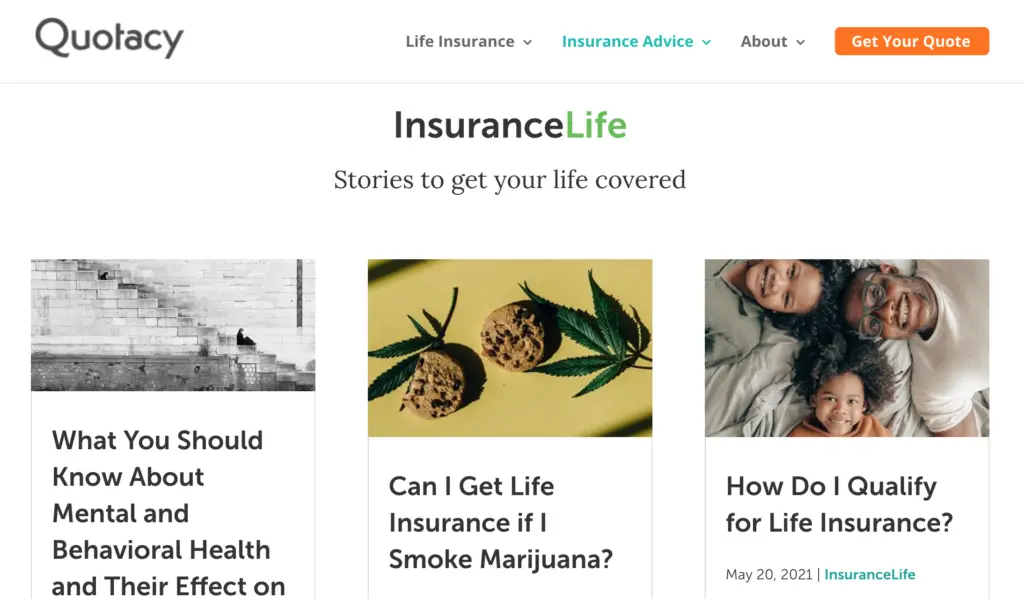
    8. QuotacyLife Blog – Stories about life and insurance

    Quotacy is the first-ever online marketplace to offer life insurance quotes without asking for contact information. They have a mission to provide an easy online shopping experience that has the family’s best interest in mind.

    Their articles are structured in three categories – InsuranceLife, LifeStyle and WealthStyle. See some of my hand-picked posts:

    They also have a Video Q&A section where they cover everything from researching what type of life insurance policy to buy to how to get the best prices for coverage.

    9. LifeQuote Blog – Content from life insurance purists

    LifeQuote is another life insurance specialist who has been in the business for over 30 years. They provide instant online quotes and help consumers to shop for life insurance with the lowest rate among different carriers.

    Check out some of their posts:

  • Auto insurance is up by more than 15% this year in some states. Here’s how to keep your premium down

    As with many line items in your household budget, your auto insurance probably costs more this year than in 2022.

    How much more?

    It depends on a variety of factors, including where you live. Nationally, the average for full coverage — generally defined as liability, collision and comprehensive — is $2,014 in 2023, up about 2.6% from 2022, according to a new study from Bankrate.

    But in some states, the jump is above 15%. That includes 16.7% in Illinois — up $258 to $1,806 — as well as 15.4% in Alaska (up $260 to $1,946) and 15.2% in Florida, up $421 to $3,183.

    More from Personal Finance:
    U.S. credit card debt hits a record $930.6 billion
    What to do if you’re struggling with auto loan payments
    States are holding $70 billion in unclaimed assets

    The Sunshine State also is one of two spots where the average premiums have crossed the $3,000 mark — the other is New York, at $3,139.

    There are two states where the average has dropped this year: New Jersey, down 7.2% to $1,754, and Massachusetts, where it slid 2.6% to $1,262.

    Of course, the exact amount you pay also is based on things like your car’s make and model, and your specific coverage choices, as well as your age and driving record.

    While auto insurance tends to eat up a small share of a person’s income — about 3% for the average person, according to the Bankrate study — you may be able to reduce it even further.

    Here are some expert tips for getting the cost down.

    Try improving your credit score

    If your state allows it — and most do — insurers can use your credit information to price policies, said Mark Friedlander, spokesman for the Insurance Information Institute. Industry research shows that drivers who manage their credit well have fewer claims, he said.

    The average annual premium for someone with very good or excellent credit — generally, above 740, on a scale of 300 to 850 — is $1,764, according to the Bankrate study. In contrast, a poor credit score — below 580 — yields an average yearly premium of $3,479. That’s an additional $1,715.

    In other words, it’s worth trying to get your score up if there’s room for improvement. You also could benefit from getting better terms on loans and credit cards with a higher score.

    Ask about all discounts

    Some insurers offer discounts for a variety of things, ranging from your car having an antitheft device to having more than one car on the policy or “bundling” — getting both auto and homeowners (or renters) insurance from the same provider.

    Bundling can save you 8% yearly, according to Insurify. Or, if you are a member of the military, you could save 2.2%. And if you take a driver safety training course as an older American, you could save as much as 15.2%.

    Additionally, low mileage may yield a discount. Some insurers offer discounts for driving a lower-than-average number of miles per year.

    “If you’re working from home now, I’d definitely let your insurance company know you’re not commuting to work,” said Brian Moody, executive editor of Kelley Blue Book.

    How to manage your money when inflation is high

    VIDEO01:21
    How to manage your money when inflation is high

    Consider increasing your deductible

    A deductible is the amount you pay out of pocket when you file a claim. The higher the deductible, the lower the premium.

    If you were to increase your deductible to $500 from $250, it could reduce your coverage cost by 15% to 30%, Friedlander said.

    However, he said, “be sure you have enough money set aside to pay the cost differential out of pocket if you file a claim.”

    Shop around

    Preferably once a year, compare your costs to other insurance options.

    While cost isn’t the only consideration — you also want a company with sold financials and good service — it’s worth checking whether there’s a less expensive policy available at another insurer.

    SIGN UP FOR OUR NEWSLETTERYOUR WEALTH

    Weekly advice on managing your money

    Get this delivered to your inbox, and more info about about our products and services.
    By signing up for newsletters, you are agreeing to our Terms of Use and Privacy Policy.

    “Auto insurance is extremely competitive and companies want your business to grow their market share,” Friedlander said. “Prices can vary significantly from company to company, so it pays to shop around.”

    Explore usage-based insurance

    Many insurance companies offer usage-based insurance policies.

    These programs can generate premium discounts by “allowing the insurer to monitor how you drive and your driving habits — speed, acceleration patterns, braking patterns — through a mobile app or plug-in device in your vehicle,” Friedlander said.

    Consider less coverage on older cars

    While states require you to have a minimum amount of car insurance, which differs from place to place, you may be able to drop your comprehensive or collision coverage if your car is paid off and, perhaps, isn’t worth much.

    Collision covers what you’d expect — accidents with another car or an object like a telephone pole — and comprehensive covers things non-collision events such as theft or a tree falling on your car.

    “If your car is worth less than 10 times the premium, purchasing these optional coverages may not be cost-effective,” Friedlander said.

  • Some 5 reasons why you should consider getting insurance

    We hear about insurance all the time: Insurance for assets, life etc. But many people don’t consider taking insurance policies because they don’t really know how they can benefit from it. When you buy an insurance policy, you’re buying a promise. It’s a promise that if something catastrophic happens in your life, your insurance will take you back to the position you were before it happened. So, what do you really stand to gain from this promise?

    Below are a few benefits of insurance:

      1. Risk coverage – We incur risks during our everyday lives: going out, coming in, doing business, and making use of our assets all come with their fair share of risks. Having an insurance policy provides you with coverage for the daily risks we incur. Should there be any unplanned events, insurance ensures that there is soft landing for you and that you are able to recover from losses faster. Policies such as car insurancehealth insurance  will help you to prepare for future occurrences.


      1. Peace of mind – When you are protected, you’re at peace! Thinking of everyday risks and providing risk management solutions can bug you down. But if you’re able to move the risks over to a professional (an insurer), then you will enjoy peace of mind and live free of worries.


      1. Living Benefits: Contrary to popular belief, benefits of life insurance policies can be enjoyed while you’re alive. In addition to death benefits (which is standard in all life insurance policies), there are also benefits such as critical illness, permanent disability covers which can be enjoyed while a person is alive. Also, life insurance policies offer cash back benefits, tax rebates, returns on investments/savings amongst other living benefits.


      1. Enjoy life – Insurance ensures that you can ‘live your best life’ without worries of fear. When you are protected, you can explore life’s possibilities. For instance, if you enjoy adventure, you can travel rest assured with your travel insurance policy. If you love arts, you can collect what you like and protect them under your all-risks policy.


    1. Live Healthy: It is popularly said that ‘health is wealth’. Health care can be quite expensive. Having a health insurance policy keeps you rest assured that you will not have to spend so much should there be any instance of illness. Also, many health insurance policies provide health check benefits and preventive health care services which ensure that health issues can be detected early and addressed.

    Getting an insurance policy is in your best interest, as you have a promise that help will come to you during any unforeseen circumstances.

  • Life insurance premium expected to maintain record levels through 2024

    Enough positive variables are in play for LIMRA analysts to project record-level life insurance premium through 2024.

    Specifically, December 2020 changes to the Internal Revenue Service tax code criteria that cash value life insurance policies must meet to retain tax-advantaged status.

    “While persistent inflation in 2023 will likely impact middle-income consumers’ demand for life insurance, particularly whole life and term products, the changes made to [the tax code] will likely continue to boost sales of accumulation products,” explained John Carroll, senior vice president, LIMRA and LOMA.

    Variable universal life and indexed universal life are two products who benefit from the IRS change, he added, by allowing consumers to expand the cash value. “There are many ways consumers can use their cash value,” Carroll said.

    Fueled by the COVID-19 pandemic, life insurance premium hit record highs in 2021. That strong growth continued in the first half of 2022, then tailed off, according to LIMRA’s U.S. Retail Individual Life Insurance Sales Summary for Fourth Quarter 2022.

    Life insurance premium totaled $15.3 billion in 2022, roughly level with 2021.

    “Life insurance sales slowed in the second half of the year as consumers’ worries about inflation and the economy increased and concerns about COVID-19 declined,” Carroll said.

    Inflation a downer

    Economic projections suggest inflation will remain high through this year, Carroll said. Total new annualized premium fell 13% in fourth quarter 2022, LIMRA reported. All product lines experienced declines in the fourth quarter. Policy sales fell 10% in both the quarter and the year.

    “Inflation and economic uncertainty have an outsized impact on middle-income consumers,” noted Carroll. “Our research shows 1 in 10 middle-income consumers said they have put off buying or said they would put off buying needed insurance due to worsening economic conditions. Not surprisingly this impacted whole life and term sales in 2022.”

    Whole life new premium dropped 19% in the fourth quarter of 2022, compared with results from the prior year. Fourth quarter of 2021 WL premium experienced the strongest quarterly premium growth for WL in 30 years. Overall, WL premium totaled $5.8 billion in 2022. While 5% lower than in 2021, it remains above pre-pandemic sales results. WL premium represented 38% of the individual life insurance market in 2022.

    Term new premium growth fell 5% in the fourth quarter, year-over-year. In 2022, term new premium was $2.8 billion, 5% lower than the 2021 results. Term premium held a 19% market share in 2022.

    For the second consecutive quarter, variable universal life new premium declined. VUL new premium fell 13% in the fourth quarter 2022, compared with the prior year’s growth of 65%. VUL premium totaled $1.8 billion in 2022, an 8% hike from 2021. VUL new premium represented 11% of the life insurance market in 2022.

    Compared with the 29% premium growth for indexed universal life (IUL) in the fourth quarter 2021, IUL new premium fell 5% in the fourth quarter 2022. For the year, IUL new premium totaled $3.9 billion, up 13% over 2021 results. IUL held 25% of the total individual life insurance market in 2022.

    Fixed universal life new annualized premium dropped for the third consecutive quarter, down 31% in the fourth quarter, compared with prior year. In 2022, fixed UL new premium totaled $1.1 billion, a decline of 17% for the year. Fixed UL market share was 7% in 2022.

    Applications up

    According to MIB Group, year-over-year life insurance application activity grew in January, up 8.6%, and February 2023, up 3%. The last time applications had positive growth was in November 2021, Carroll noted. Meanwhile, 41% of American adults say they need or need more life insurance.

    “While today’s inflation and economic concerns may delay people from taking action immediately, the memory of the pandemic will remain and we believe as the industry innovates products and services both consumers and distribution will respond,” Carroll said.

    LIMRA research shows carriers can meet the demand if they meet three challenges, Carroll explained:

    1. Continue to leverage advances in technology to reach underserved markets and streamline the process for financial professionals, particularly those in the wealth space.
    2. Product innovation, including embedded products (get life insurance coverage with homeowners or auto insurance), and combination products, allowing consumers to mitigate multiple risks (LTCI, CI etc.),
    3. Customer experience: Build products or programs that will help and reward clients to better manage health/wellness.

    InsuranceNewsNet Senior Editor John Hilton covered business and other beats in more than 20 years of daily journalism. John may be reached at john.hilton@innfeedback.com. Follow him on Twitter @INNJohnH.

    © Entire contents copyright 2023 by InsuranceNewsNet.com Inc. All rights reserved. No part of this article may be reprinted without the expressed written consent from InsuranceNewsNet.com.